
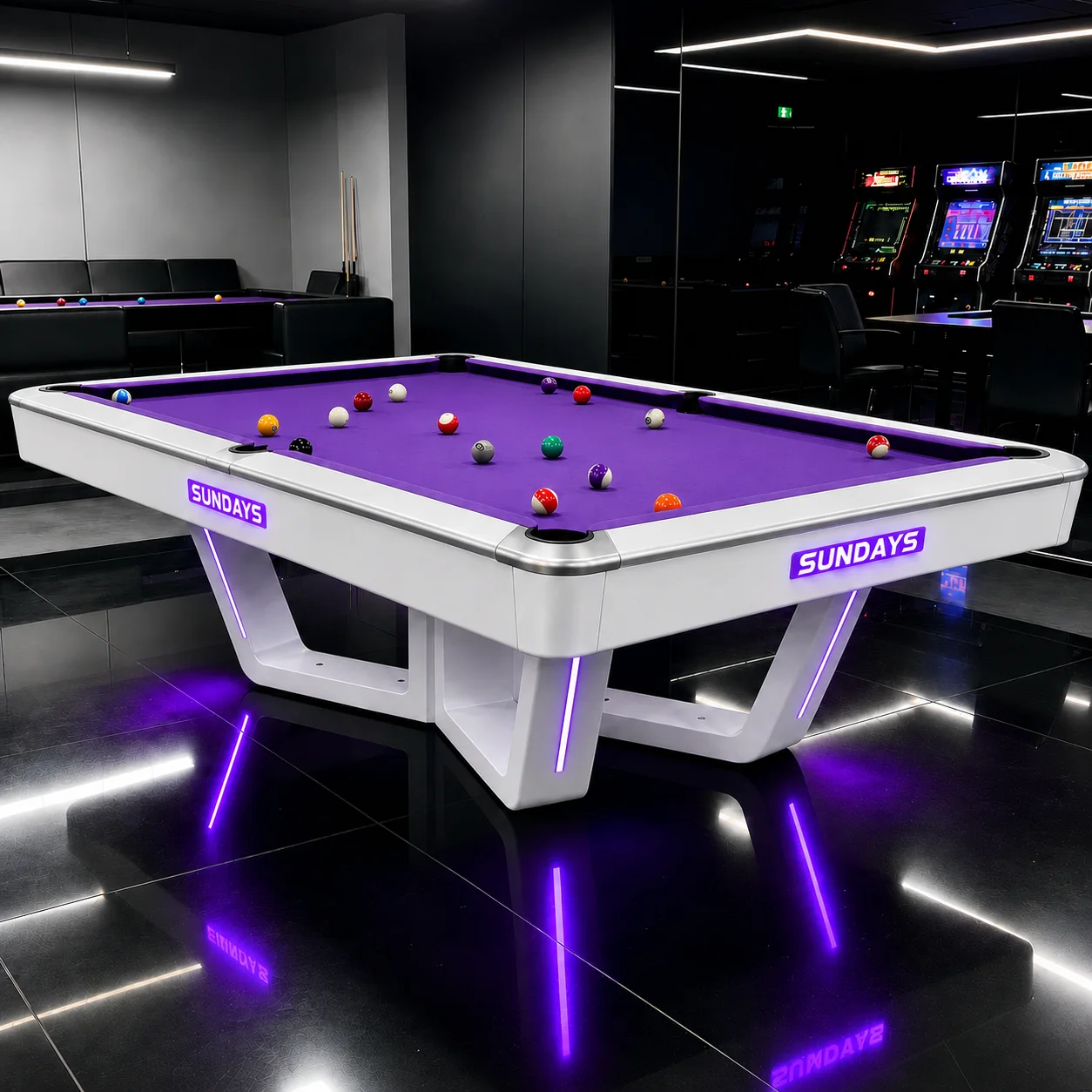
“LED pool table” or “automatic ball return” describes a feature, not an electrical installation specification. Venues need the selected model’s documentation before outlets, floor boxes or cable routes are fixed. This guide shows what to request and how to coordinate the supplier, electrician and installer without guessing a universal voltage or circuit size.
Ask the supplier for the exact voltage, frequency, rated input, plug or connection type, controller location, cable route and service access for the quoted table. A qualified local electrician should then confirm the circuit, protection, grounding and installation method under local rules.
Collect the electrical schedule before site work
| Field | What to request | Approval owner |
|---|---|---|
| Supply | Voltage, frequency and rated input for the quoted model | Supplier + local electrician |
| Connection | Plug, fixed connection or adapter requirements | Local electrician |
| Protection | Manufacturer requirements and applicable local protection | Local electrician |
| Controls | Switch, remote, payment controller and reset location | Venue operator |
| Cable route | Entry point, permitted routing and strain protection | Installer + electrician |
| Service access | How powered parts are isolated and reached | Operator + service team |
Coordinate the outlet with play and service access
Mark the final table footprint, player cueing zone, staff route and maintenance access on one plan. A convenient outlet can still create a trip hazard or become inaccessible after assembly. Confirm whether the cable approaches from the wall, floor or table base and how the manufacturer intends it to be protected.
For several tables, identify each model and circuit on the drawing. Do not multiply one table’s assumed requirement across the room. Lighting, payment systems, chargers, score displays and other venue equipment may be separate loads and should be included in the local electrical design.
Create a commissioning check
Before opening the venue, have the responsible people verify the installed connection, control operation, emergency or normal isolation process, cable protection and service access. Record the table identifier and the approved electrical document revision. Keep the supplier’s operating information available to the operator and maintenance team.
Electrical work should be assigned according to local law and the hazards of the task. OSHA guidance, for example, describes a qualified person as someone familiar with the construction and operation of the relevant equipment and its hazards. Requirements differ by jurisdiction; this article is a procurement checklist, not electrical design advice.
Add these questions to the table quotation
Ask whether the quoted price includes the lighting or payment system, controller, power supply, cabling within the table, plug, remote and installation instructions. Request replacement-part references for the powered components and identify what can be serviced without disturbing the playing surface.
If the product is being customized for another market, ask which electrical changes are included and what documentation accompanies that exact configuration. Do not infer certification from a logo, a marketplace category or a different model.
Frequently asked questions
Can I plan an outlet from an LED table photograph?
No. Obtain the electrical schedule and connection location for the exact quoted configuration.
Does a ball-return table always need power?
No assumption should be made. Ball return and payment control can be mechanical or powered depending on the model.
Can the supplier specify the local circuit?
The supplier can provide the equipment requirements; a qualified local electrician should design and approve the site installation under local rules.
Products mentioned in this guide
Product sources
References used for the product discussion. Listing terms can change; availability and final specifications require a quotation.